


Buying a premium ergonomic chair isn’t about picking the “best” model.
It’s about picking the right fit for your body, climate, work style, and tolerance for firmness.
Instead of listing chairs randomly, this guide walks you through a structured ergonomic chair decision tree — step by step — so you land on the chair that matches how you actually work.
Think of this as a flowchart in written form.
Let’s start at the top.
STEP 1: How Many Hours Do You Sit Daily?
4–6 Hours
You still need proper support but extreme adjustability may not be essential.
6–8 Hours
Lumbar precision and seat depth become important.
8–10+ Hours
Structural engineering matters more than softness.
Harvard Health emphasizes that maintaining neutral posture during prolonged sitting reduces spinal strain.
If you sit all day, this decision matters.
→ If you sit 8+ hours daily, continue to Step 2.
STEP 2: Do You Prefer Firm Structure or Adaptive Cushion?
This is one of the biggest differentiators in premium chairs.
Option A: Firm, Suspension-Based Support
If you prefer:
- Breathability
- Structured posture
- No cushion compression over time
Consider:
Herman Miller Aeron (Size A/B/C)
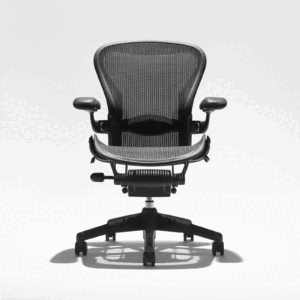
Aeron uses tensioned mesh rather than foam.
It feels supportive rather than plush.
→ If this sounds right, skip to Step 5.
Option B: Adaptive Cushioning & Adjustability
If you prefer:
- Softer seating
- Adjustable lumbar depth
- Adaptive back movement
Continue to Step 3.
STEP 3: Do You Want Maximum Lumbar Customization?
Buying a premium ergonomic chair isn’t about picking the “best” model.
It’s about picking the right fit for your body, climate, work style, and tolerance for firmness.
Instead of listing chairs randomly, this guide walks you through a structured ergonomic chair decision tree step by step—so you land on the chair that matches how you actually work.
Think of this as a flowchart in written form.
Let’s start at the top.
STEP 1: How Many Hours Do You Sit Daily?
4–6 Hours
You still need proper support but extreme adjustability may not be essential.
6–8 Hours
Lumbar precision and seat depth become important.
8–10+ Hours
Structural engineering matters more than softness.
Harvard Health emphasizes that maintaining neutral posture during prolonged sitting reduces spinal strain.
If you sit all day, this decision matters.
→ If you sit 8+ hours daily, continue to Step 2.
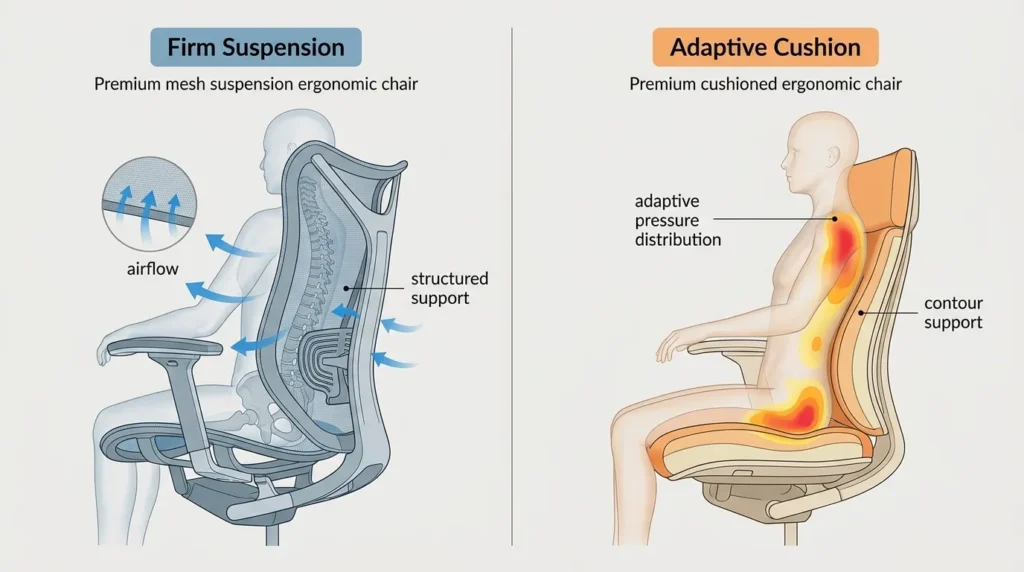
STEP 2: Do You Prefer Firm Structure or Adaptive Cushion?
This is one of the biggest differentiators in premium chairs.
Option A: Firm, Suspension-Based Support
If you prefer:
- Breathability
- Structured posture
- No cushion compression over time
Consider:
Herman Miller Aeron (Size A/B/C)
Aeron uses tensioned mesh rather than foam.
It feels supportive rather than plush.
→ If this sounds right, skip to Step 5.
Option B: Adaptive Cushioning & Adjustability
If you prefer:
- Softer seating
- Adjustable lumbar depth
- Adaptive back movement
Continue to Step 3.
STEP 3: Do You Want Maximum Lumbar Customization?
The UK Health and Safety Executive (HSE) highlights lumbar alignment as a key factor in workstation ergonomics.
If lumbar sensitivity is a concern:
Choose High Lumbar Adjustability
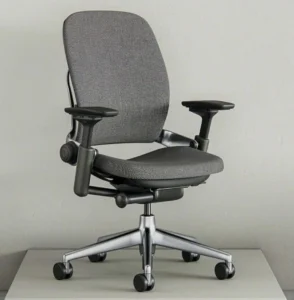
- Adjustable lumbar height
- Adjustable lumbar depth
- Seat depth slider
- Adaptive backrest
Leap is ideal if you like dialing lumbar pressure precisely.
→ If lumbar customization is top priority, Leap is often the strongest fit.
If lumbar customization is less important and upper-body flexibility matters more, go to Step 4.
STEP 4: Do You Move Your Arms Frequently or Use Multiple Devices?
If you:
- Use dual monitors
- Shift typing angles
- Work on tablet + keyboard
- Lean back while typing
Arm flexibility becomes important.
The Canadian Centre for Occupational Health and Safety (CCOHS) emphasizes that proper arm positioning reduces shoulder and wrist strain.
Choose Maximum Arm Articulation
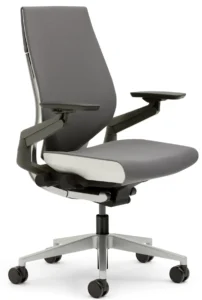
Gesture offers highly articulated armrests designed for modern device usage.
If upper-body freedom matters most → Gesture often wins.
STEP 5: Are You Tall (6'2"+) or Broad-Framed?
If yes, sizing matters.
Aeron offers three sizes (A, B, C).
Size C accommodates taller users better than one-size chairs.
If you’re tall and prefer suspension → Aeron Size C is often ideal.
If you’re tall but prefer cushion → Leap’s seat depth slider helps compensate.
STEP 6: Are You Heavier (300+ lbs)?
Structural integrity matters more than initial comfort.
The NIH notes that pressure distribution and posture alignment reduce musculoskeletal strain over time.
For heavier users:
- Aeron Size C (mesh avoids compression)
- Steelcase Leap (strong foam density)
- Steelcase Gesture (reinforced base)
Avoid chairs rated exactly at your body weight.
Margin equals durability.
STEP 7: Do You Work in a Warm or Cool Environment?
Warm climate?
Mesh breathes better → Aeron.
Cool office?
Cushioning feels warmer → Leap or Gesture.
Climate rarely appears in marketing — but by hour seven, it matters.
STEP 8: How Much Do You Move During the Day?
Mostly upright, focused work?
→ Aeron or Gesture (structured support)
Frequent position shifts?
→ Leap (adaptive back flex)
Lean-back thinking posture?
→ Gesture
Movement pattern is often more important than brand.
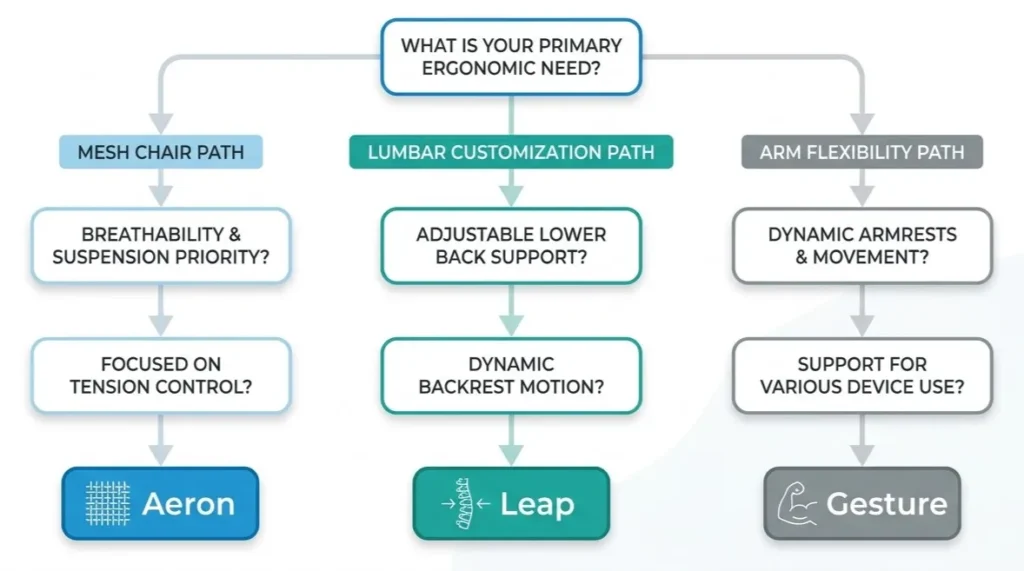
Ergonomic Chair Decision Tree Summary
Here’s the simplified flow:
8+ hours daily?
→ Yes → Suspension or Cushion?
Suspension + Breathability?
→ Aeron
Cushion + Lumbar Customization?
→ Leap
Cushion + Upper-Body Flexibility?
→ Gesture
Tall user needing size precision?
→ Aeron Size C
Heavier user needing structure?
→ Aeron or Leap
There is no universal winner.
There is a best match.
Why a Decision Tree Works Better Than “Top 10” Lists
Premium chairs are not interchangeable.
Differences include:
- Lumbar philosophy
- Seat material
- Arm engineering
- Frame sizing
- Climate suitability
A structured decision tree eliminates emotional buying and replaces it with body-fit logic.
Final Thought
At this price level, you’re not buying a chair for a year.
You’re buying it for a decade.
Choose based on:
- How you sit
- How long you sit
- How your body responds to firmness
- How much you adjust settings
The right premium chair disappears beneath you.
The wrong one reminds you it exists.
FAQ
What is the best premium ergonomic chair?
The best option depends on lumbar preference, climate, body type, and sitting duration.
Is Aeron better than Leap?
Aeron offers suspension-based support; Leap offers customizable lumbar cushioning.
Is Gesture better than Leap?
Gesture excels in arm articulation; Leap excels in lumbar customization.
Do premium chairs last longer?
Most include 12-year warranties and are engineered for long-term use.