


If you’ve ever shopped for an office chair, you’ve seen the phrase everywhere:
“Built-in lumbar support.”
Sometimes it’s a mesh curve.
Sometimes it’s a hard plastic bump.
Sometimes it’s a removable pillow strapped to the backrest.
But here’s the real question:
Do you actually need lumbar support… or is it just marketing?
Lumbar support is a feature in office chairs that helps maintain the natural inward curve of the lower back while sitting. Proper lumbar support reduces strain on the spine, improves posture, and helps prevent lower back fatigue during prolonged sitting.
First: What Is Lumbar Support?
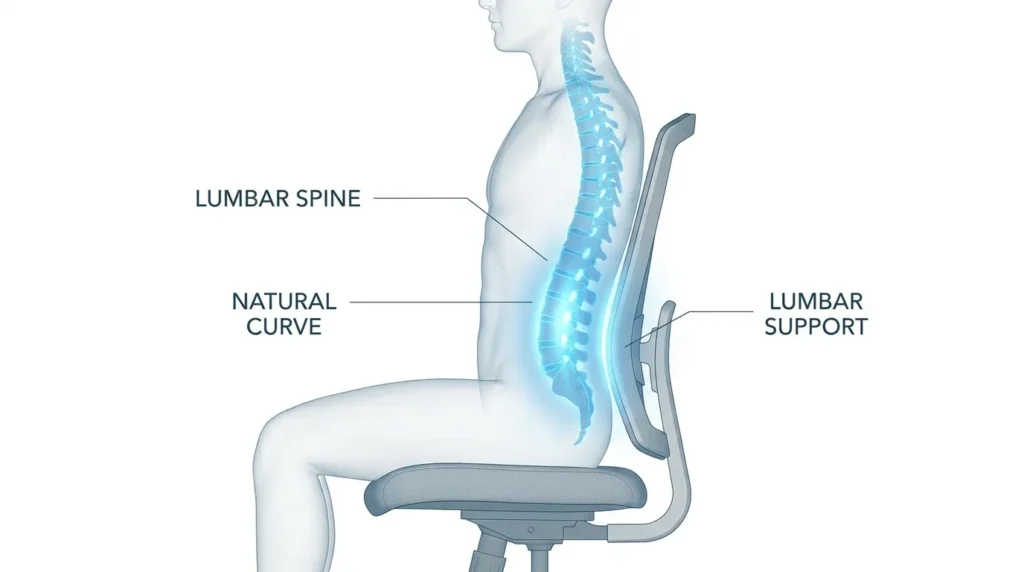
Your lumbar spine (lower back) has a natural inward curve called lordosis.
When you stand upright, that curve helps:
- Distribute spinal load
- Absorb shock
- Maintain balance
When you sit, especially for long periods, that curve tends to flatten.
Flattened lumbar curve = increased disc pressure.
Research archived through the National Institutes of Health shows that seated posture significantly influences lumbar disc loading.
Lumbar support is designed to help maintain that natural inward curve while seated.
That’s it.
No magic.
Just support.
Why the Lumbar Curve Matters When Sitting
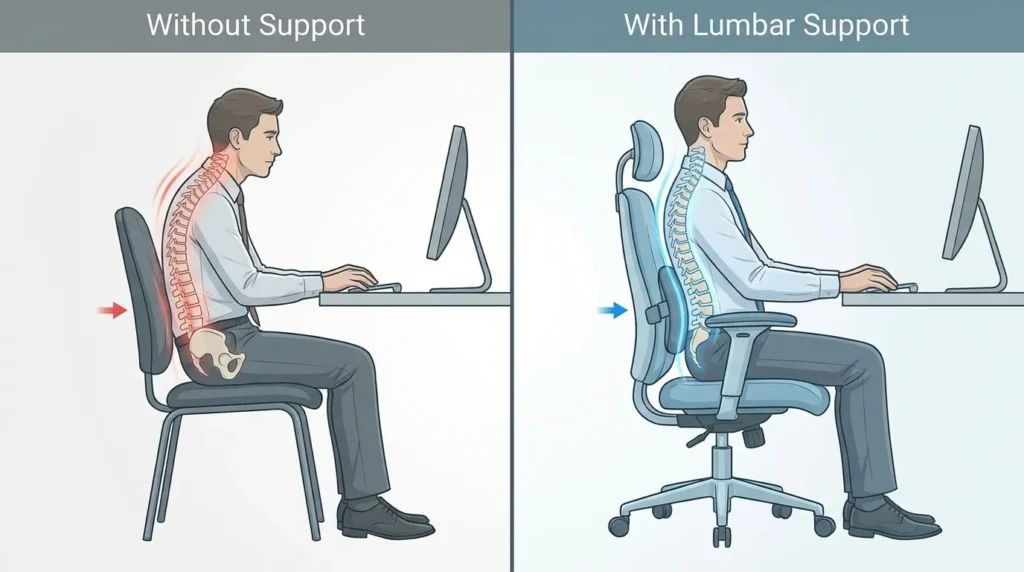
When you lose your lumbar curve:
- The pelvis rolls backward (posterior pelvic tilt)
- Spinal discs bear more pressure
- Muscles work harder to stabilize you
- Fatigue builds faster
The Occupational Safety and Health Administration (OSHA) emphasizes that proper back support is essential in computer workstation setup to reduce musculoskeletal strain.
Without lumbar support, your lower back muscles often compensate all day.
Compensation eventually turns into discomfort.
So… Do You Actually Need Lumbar Support?
In most cases — yes.
But not always in the way you think.
You likely benefit from lumbar support if:
- You sit more than 4–6 hours per day
- You feel lower back fatigue by afternoon
- You slide forward in your chair
- Your lower back loses contact with the backrest
However:
If you frequently recline and move throughout the day, your need for aggressive lumbar support decreases.
Movement reduces compression.
Stillness increases it.
The CDC consistently recommends breaking up prolonged sitting to reduce musculoskeletal strain.
Lumbar support helps but it doesn’t replace movement.
The 3 Types of Lumbar Support (And What Actually Works)
Not all lumbar support is equal.
Let’s compare.
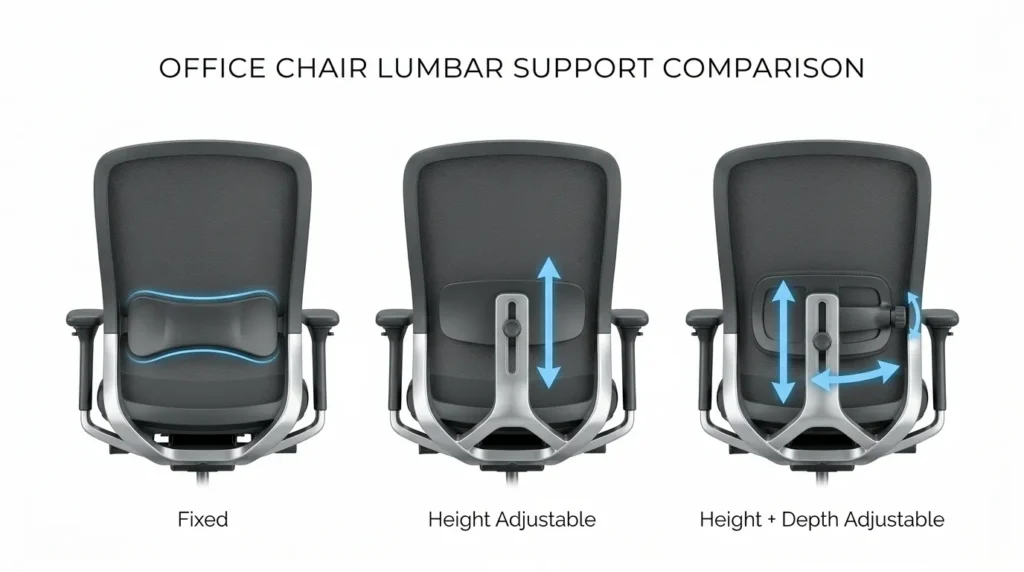
1️⃣ Fixed Lumbar Support
This is a built-in curve that doesn’t move.
Pros:
- Better than nothing
- Low maintenance
Cons:
- One-size-fits-all rarely fits anyone perfectly
- May sit too high or too low
If the curve doesn’t align with your belt line, it won’t properly support your lumbar spine.
2️⃣ Adjustable Lumbar Support (Height Only)
This allows vertical movement.
Pros:
- Can align with your natural curve
- Better customization
Cons:
- Depth may not adjust
For many people, height adjustment alone solves most support issues.
3️⃣ Adjustable Lumbar Support (Height + Depth)
This is the most effective type.
It allows:
- Vertical positioning
- Forward/backward pressure adjustment
Why depth matters:
Too much pressure can force excessive arching.
Too little support allows flattening.
Proper lumbar support should feel supportive not aggressive.
Does Lumbar Support Reduce Back Pain?
Here’s the honest answer:
Lumbar support can reduce lower back strain.
But it doesn’t “cure” back pain.
Studies indexed through PubMed frequently show that maintaining lumbar lordosis reduces disc pressure compared to slouched sitting.
However:
- Weak glutes
- Tight hip flexors
- Poor monitor position
- Long periods without movement
…all contribute to discomfort as well.
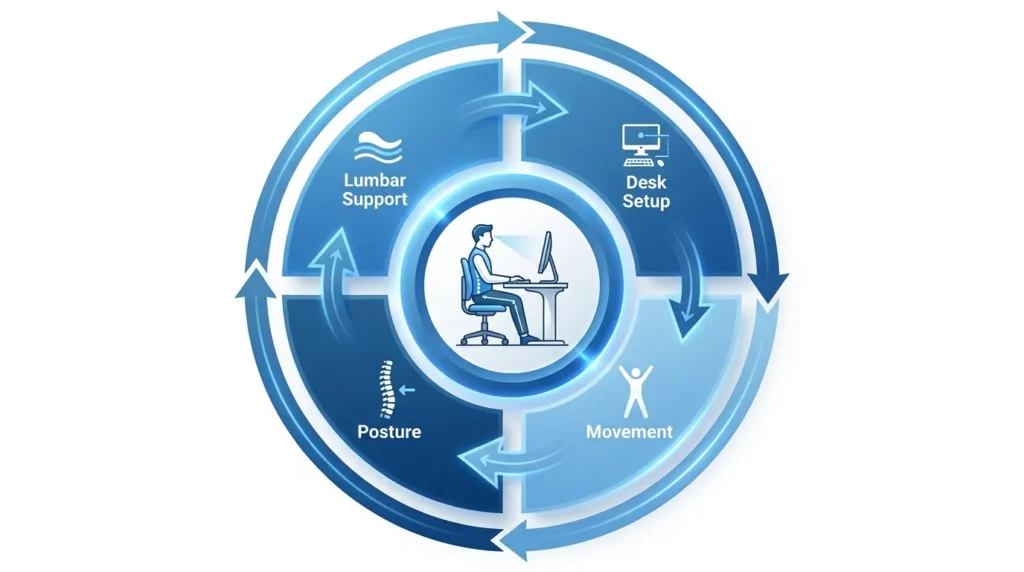
Lumbar support is one piece of the system.
When Lumbar Support Might Not Be the Main Issue
Sometimes people blame the chair when the real issue is:
- Seat height too low
- Seat depth too long
- Monitor too low (causing forward lean)
- No movement breaks
The National Institute for Occupational Safety and Health (NIOSH) reinforces that workstation ergonomics must address the entire setup, not just the chair back.
Lumbar support helps maintain spinal alignment.
But if the rest of your setup is off, it can’t compensate.
How to Tell If Your Lumbar Support Is Working
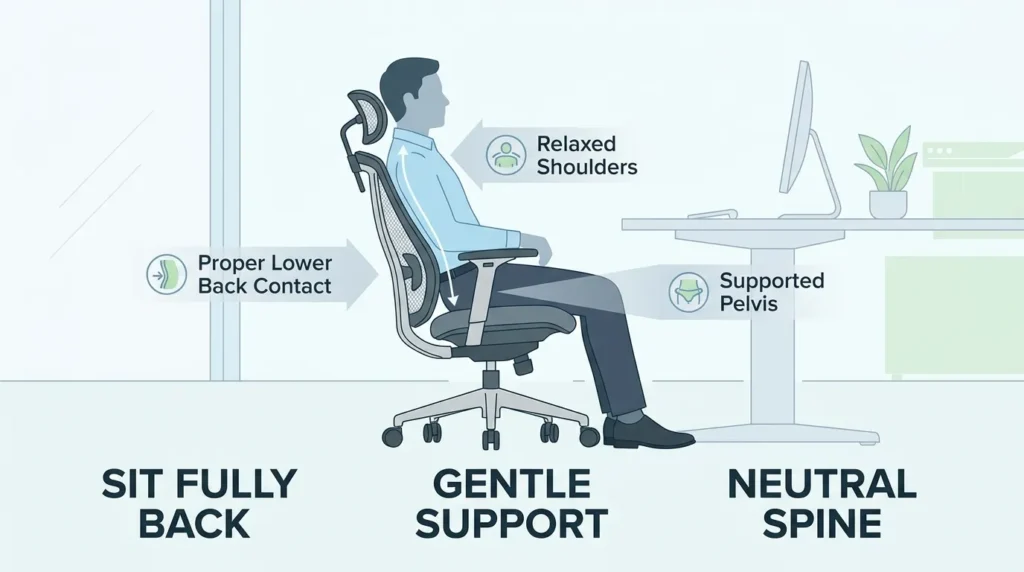
Quick test:
- Sit fully back in your chair.
- Relax slightly.
- Notice your lower back.
Ask yourself:
- Does your lower back stay in contact with the backrest?
- Does it feel gently supported,not forced?
- Can you recline without losing contact?
If your lower back collapses when you relax, support is insufficient.
If it feels like a hard object digging into your spine, it’s too aggressive or poorly positioned.
Proper lumbar support should feel subtle.
Not dramatic.
What About Lumbar Cushions?
Lumbar cushions can help especially if:
- Your chair has no built-in lumbar support
- The built-in support is too low or too shallow
But quality varies.
Look for:
- Adjustable straps
- Medium-density foam (not overly soft)
- Contoured shape that matches natural curve
Soft pillows flatten quickly and lose effectiveness.
Support should maintain shape.
Can Too Much Lumbar Support Cause Problems?
Yes.
Over-aggressive lumbar pressure can:
- Increase muscle tension
- Force excessive spinal arching
- Cause discomfort higher in the back
Support should maintain neutral alignment, not exaggerate it.
If you feel pushed forward unnaturally, reduce depth or reposition.
The Bigger Picture
Here’s what most chair ads won’t tell you:
Lumbar support reduces strain.
Movement reduces compression.
Strength reduces vulnerability.
You need all three.
The CDC’s guidance on physical activity reinforces the importance of regular movement throughout sedentary workdays (source).
A well-adjusted chair supports you.
But your body still needs to move.
Final Answer: Do You Actually Need Lumbar Support?
If you sit for long periods, yes you likely benefit from it.
Especially if:
- You work at a desk daily
- You feel afternoon lower back fatigue
- You struggle to maintain upright posture
But lumbar support isn’t a miracle fix.
It’s a stabilizer.
Think of it as reducing background strain so your muscles don’t have to work overtime.
When combined with:
- Proper seat height
- Correct monitor position
- Regular movement breaks
…it makes a noticeable difference.
Most people don’t need extreme support.
They need properly positioned support.
There’s a big difference.
FAQ
Do I really need lumbar support in an office chair?
Most people who sit for extended periods benefit from lumbar support because it helps maintain the natural curve of the lower back and reduces muscle fatigue.
Is adjustable lumbar support better than fixed lumbar support?
Yes. Adjustable lumbar support allows you to match the support to your body shape and sitting posture.
Can lumbar support reduce lower back pain?
Lumbar support can reduce strain and improve posture, but it should be combined with proper desk ergonomics and regular movement.
Where should lumbar support sit on your back?
It should fit into the natural inward curve of your lower back, roughly around your belt line.
Can too much lumbar support be harmful?
Yes. Excessive lumbar pressure can force the spine into an unnatural arch and cause discomfort.
Are lumbar support cushions effective?
Yes, especially if your chair lacks built-in lumbar support, provided the cushion maintains its shape and fits your lower back properly.