


Neck and shoulder pain from desk work is one of the most common complaints among office workers. While many people treat neck stiffness or shoulder tension as isolated problems, poor desk posture often affects the entire spine—including the lower back. Understanding this connection is the first step toward reducing discomfort and improving workplace ergonomics.
👉 Neck, shoulder, and lower back pain are connected.
They’re not separate problems.
They’re part of the same posture chain.
The Posture Chain: Why Everything Is Linked
Your spine isn’t divided into isolated sections.
It’s one continuous structure:
- Cervical spine (neck)
- Thoracic spine (mid-back)
- Lumbar spine (lower back)
When one section shifts out of alignment, the others compensate.
This is called regional interdependence, a concept widely recognized in musculoskeletal care.
The Cleveland Clinic explains that posture-related strain often spreads across multiple spinal regions because muscles and joints work as a system.
If your head moves forward…
Your shoulders round…
Your lower back responds.
How Desk Work Triggers the Chain Reaction
Let’s break it down.
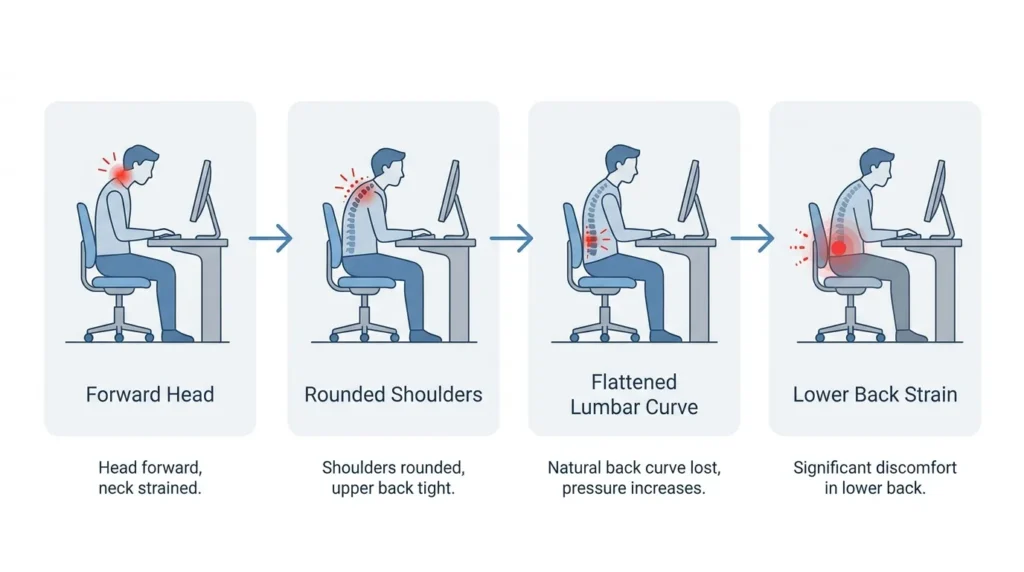
1️⃣ Forward Head Posture
When you lean toward your screen:
- Your head shifts forward
- Neck muscles tighten
- Upper traps overwork
- Shoulders elevate
But here’s the hidden part:
As your upper spine rounds forward, your lower spine often flattens.
That reduces lumbar support.
Now your lower back muscles must work harder to stabilize you.
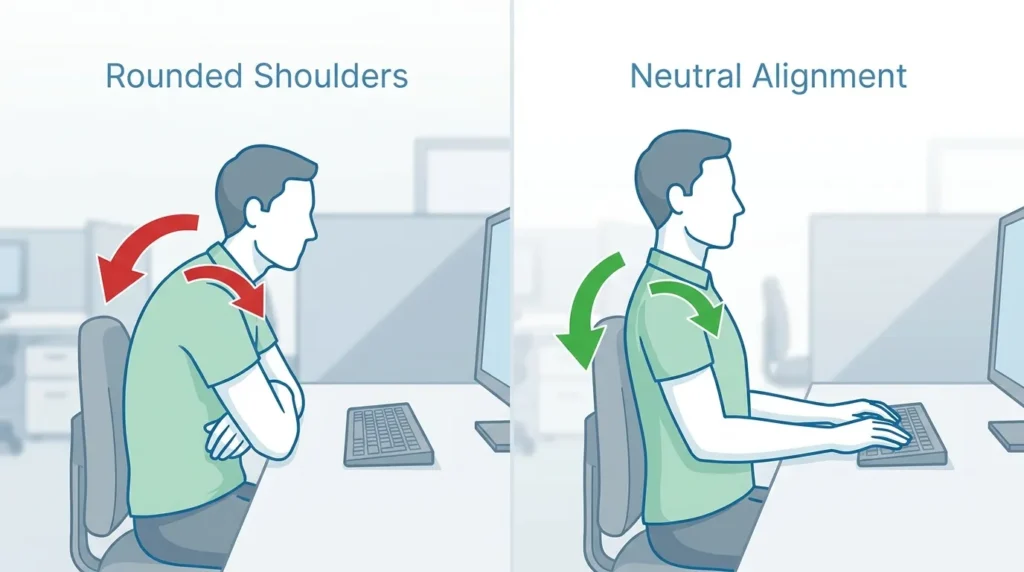
2️⃣ Rounded Shoulders
Typing and mouse use encourage:
- Internal shoulder rotation
- Collapsed chest
- Tight pectoral muscles
This creates tension in the upper back.
To compensate, the lower spine may:
- Increase curvature
- Decrease curvature
- Shift pelvis forward
Either way, strain spreads downward.
3️⃣ Static Sitting
Sitting for long periods:
- Weakens deep core stabilizers
- Reduces glute activation
- Increases disc compression
The Harvard Health Publishing notes that prolonged sitting without posture changes contributes to musculoskeletal discomfort, especially in the back and neck.
Neck tension + inactive core = lower back overload.
Why Treating Only the Neck Doesn’t Work
Many people:
- Massage their shoulders
- Crack their neck
- Use heat packs
Temporary relief.
But if your desk setup still causes forward posture, the cycle repeats.
Upper body tension often reflects lower body instability.
The spine is a stack—misalignment at the top shifts pressure below.
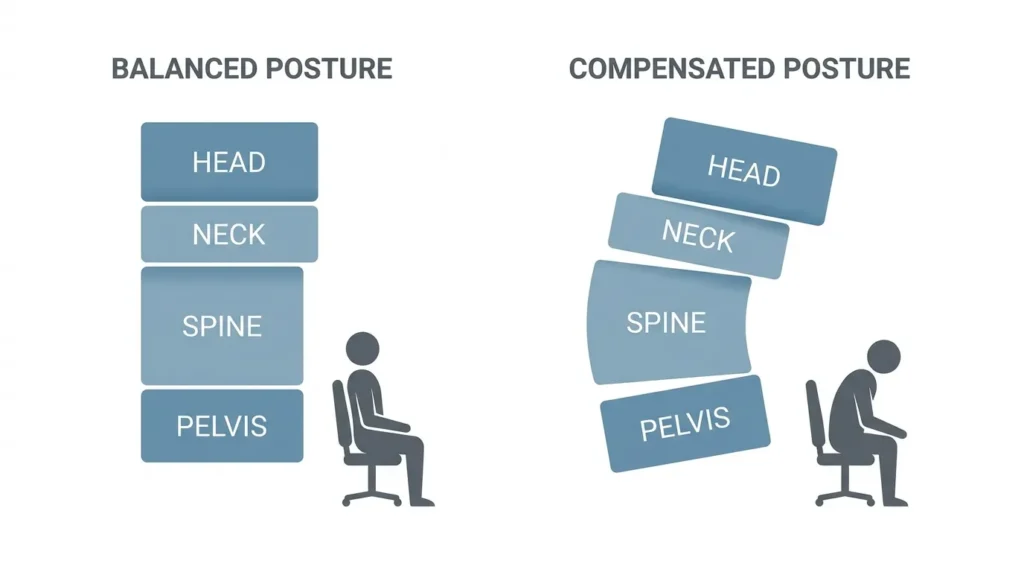
The Biomechanical Connection (Simple Version)
Imagine your body like a stack of blocks:
If the top block (head) moves forward,
The blocks below must adjust to prevent falling.
Your lower back becomes a shock absorber.
Over time:
- Muscles fatigue
- Ligaments strain
- Discomfort builds
The Occupational Safety and Health Administration emphasizes neutral spine alignment to reduce strain across the entire back, not just one region.
Signs Your Neck Pain Is Affecting Your Lower Back
You may notice:
✔ Tight neck + dull lower back ache
✔ Shoulders feel heavy by afternoon
✔ Slouching increases as day progresses
✔ Back pain improves when you stand
✔ Lower back pain worsens after screen-heavy days
That pattern signals posture-driven strain.
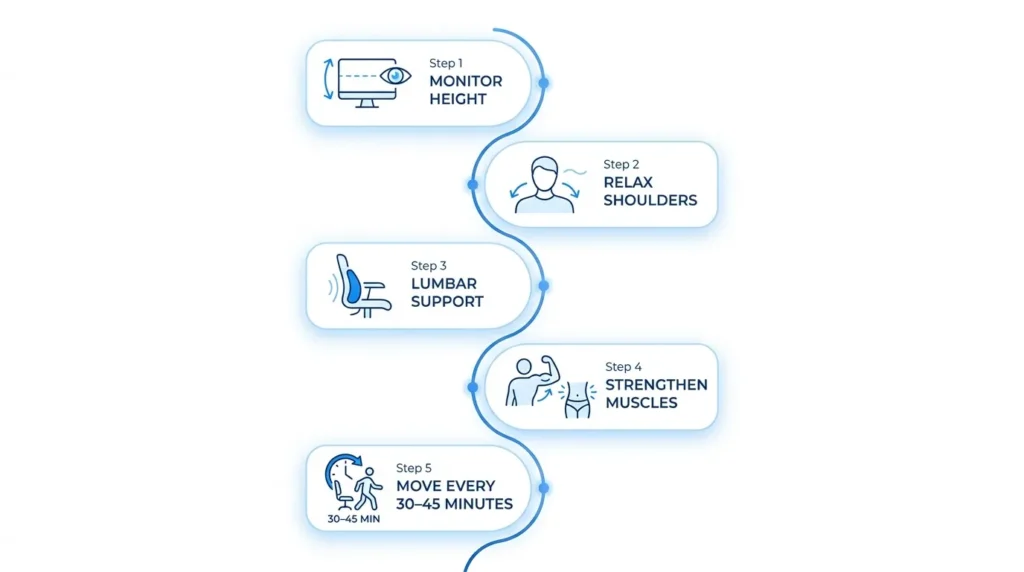
How to Break the Chain
You must address:
- Head position
- Shoulder alignment
- Core engagement
- Sitting duration
Not just one area.
Step 1: Fix Monitor Height
Top of screen should be:
- At or slightly below eye level
- About arm’s length away
If your monitor is too low, you’ll lean forward.
That begins the chain reaction.
Step 2: Relax the Shoulders
Check this right now:
Are your shoulders lifted slightly?
Let them drop.
Most people hold subtle tension without noticing.
Step 3: Support the Lumbar Spine
Proper lumbar support:
- Maintains natural curve
- Prevents flattening
- Reduces compensation above
When the lower back is stable, upper tension often decreases.
Step 4: Strengthen the Weak Links
Desk work commonly weakens:
- Deep neck flexors
- Mid-back stabilizers
- Core muscles
- Glutes
Short daily exercises:
✔ Chin tucks
✔ Scapular retractions
✔ Glute bridges
✔ Dead bugs
✔ Thoracic extensions
Strong support muscles reduce compensatory strain. Maintaining proper ergonomic posture is essential for spinal health.
Step 5: Increase Movement Frequency
Static posture drives pain.
Move every 30–45 minutes.
Even 1–2 minutes resets tension patterns.
Standing, stretching, and walking redistribute load.
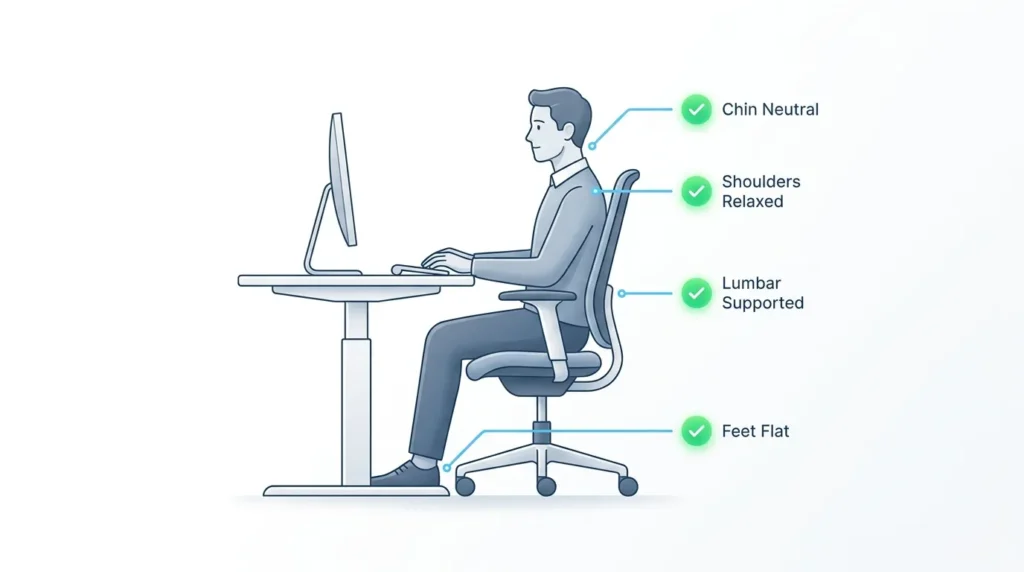
Quick Self-Assessment
Sit normally at your desk.
Ask:
- Is my chin jutting forward?
- Are my shoulders rounded?
- Is my lower back supported?
- Are my feet flat?
Small corrections reduce full-chain strain.
When to Seek Professional Help
Consult a healthcare provider if you experience:
- Persistent pain despite ergonomic changes
- Numbness or tingling
- Radiating pain into arms or legs
- Weakness
Not all pain is posture-related but much desk discomfort is.
FAQ
Can neck posture cause lower back pain?
Yes. Forward head posture alters spinal alignment, increasing strain on the lower back.
Why do my shoulders hurt when I sit at a desk?
Likely due to rounded posture, elevated shoulders, or improper desk height.
Does fixing lumbar support reduce neck pain?
Often yes — stabilizing the lower spine reduces compensatory tension above.
Is standing better for neck and shoulder pain?
Alternating between sitting and standing helps reduce static strain.