


If your desk feels too high…
If your shoulders tense up while typing…
If your feet dangle or your knees feel cramped…
Your ideal desk and chair height may be wrong.
Even small mismatches in height can strain your:
- Lower back
- Shoulders
- Neck
- Wrists
Let’s calculate your correct ergonomic setup.
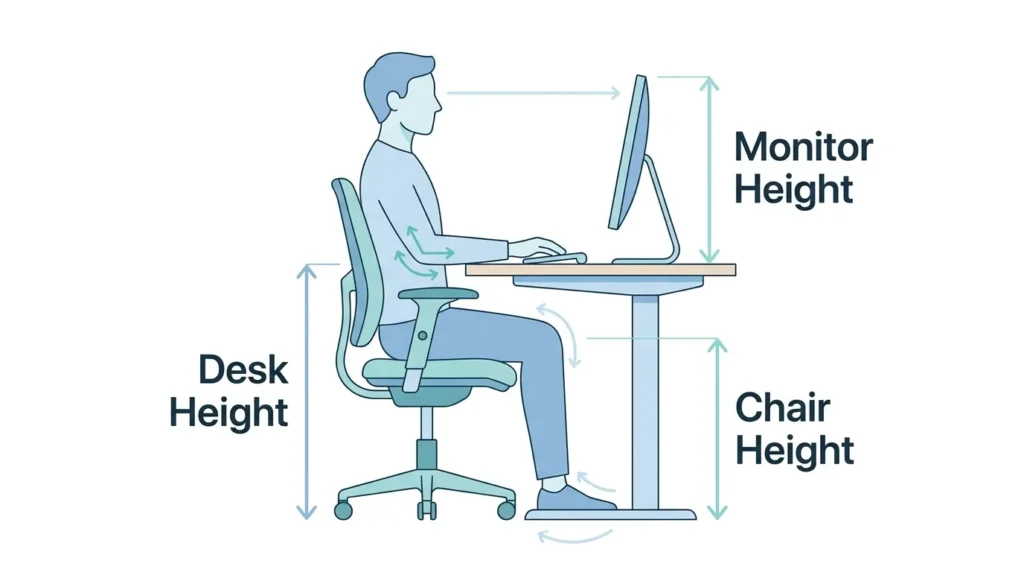
Step 1: Measure Your Seated Elbow Height
This is the foundation of proper desk height.
How to Measure
- Sit upright in a neutral posture
- Bend your elbows at 90°
- Relax your shoulders
- Measure from the floor to the bottom of your elbow
This is your seated elbow height.
Desk Height Calculator (Simple Formula)
Ideal Desk Height = Seated Elbow Height
Your desk surface should align with your elbows when they are bent at 90°.
This ensures:
- Neutral wrist alignment
- Relaxed shoulders
- Reduced upper back strain
According to the Occupational Safety and Health Administration, keeping forearms parallel to the floor reduces musculoskeletal stress in office environments.
Step 2: Determine Correct Chair Height
Now let’s calculate chair height properly.
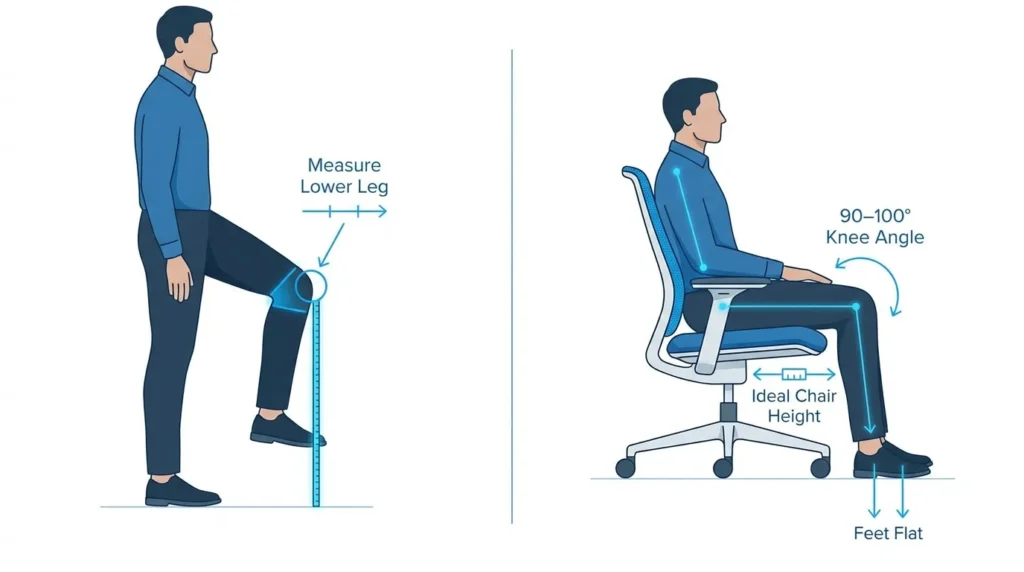
How to Measure Lower Leg Length
- Stand barefoot
- Measure from floor to underside of knee
- This equals your approximate ideal chair seat height
Chair Height Formula
Ideal Chair Height = Lower Leg Length (minus 1–2 cm for shoe thickness adjustment)
Your feet should:
✔ Rest flat on the floor
✔ Form a 90–100° knee angle
✔ Keep thighs parallel to the ground
The Cleveland Clinic emphasizes neutral joint positioning to prevent lower back strain during prolonged sitting.
Quick Reference Table by Body Height
| Your Height | Approx. Desk Height | Approx. Chair Height |
| 5'0" (152 cm) | ~60–63 cm | ~38–40 cm |
| 5'4" (163 cm) | ~65–68 cm | ~40–43 cm |
| 5'8" (173 cm) | ~69–72 cm | ~43–46 cm |
| 6'0" (183 cm) | ~72–75 cm | ~46–49 cm |
| 6'2"+ (188+ cm) | ~75–78 cm | ~48–51 cm |
These are general ranges. Individual limb proportions vary.
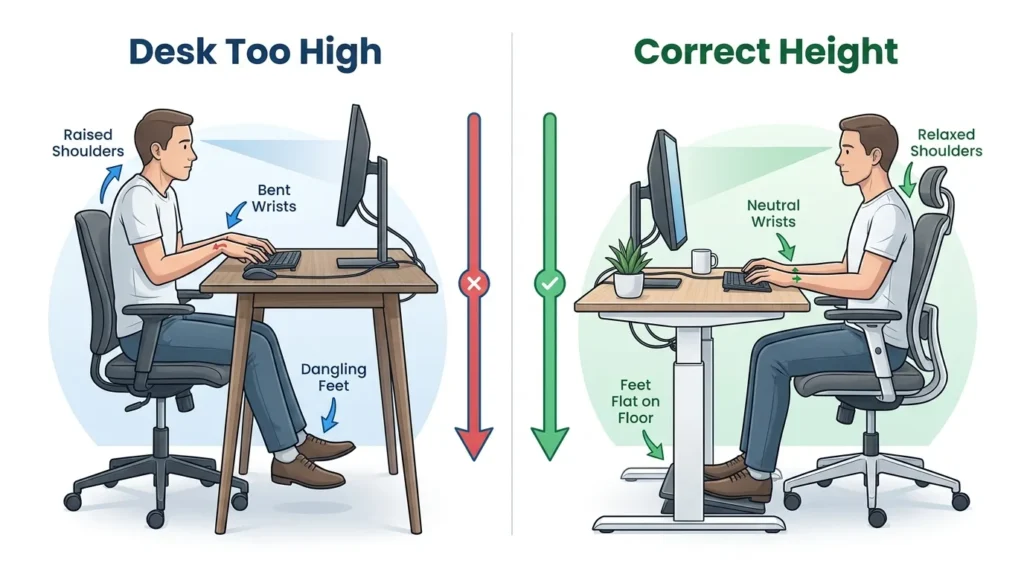
Why Standard Desk Heights Don’t Work for Everyone
Most fixed desks are around:
28–30 inches (71–76 cm)
That may be perfect for someone 5'10".
But too high for someone 5'2".
And too low for someone 6'3".
This mismatch causes:
- Shoulder elevation
- Wrist extension
- Lumbar rounding
- Neck leaning
The Harvard Health Publishing notes that poorly adjusted workstations contribute to repetitive strain and posture-related discomfort.
What If Your Desk Is Too High?
Solutions:
✔ Raise chair height
✔ Add footrest
✔ Use keyboard tray
✔ Switch to adjustable desk
If you raise your chair, your feet must still rest flat. If not, use a footrest.
What If Your Desk Is Too Low?
You may notice:
- Hunched shoulders
- Forward neck
- Rounded upper back
Solutions:
✔ Raise desk (if adjustable)
✔ Add desk risers
✔ Use monitor riser
✔ Consider sit-stand desk
Monitor Height Reminder
Even with correct desk height, monitor positioning matters.
Top of screen should be:
✔ At or slightly below eye level
✔ About an arm’s length away
Incorrect monitor height often causes more neck strain than desk height itself.
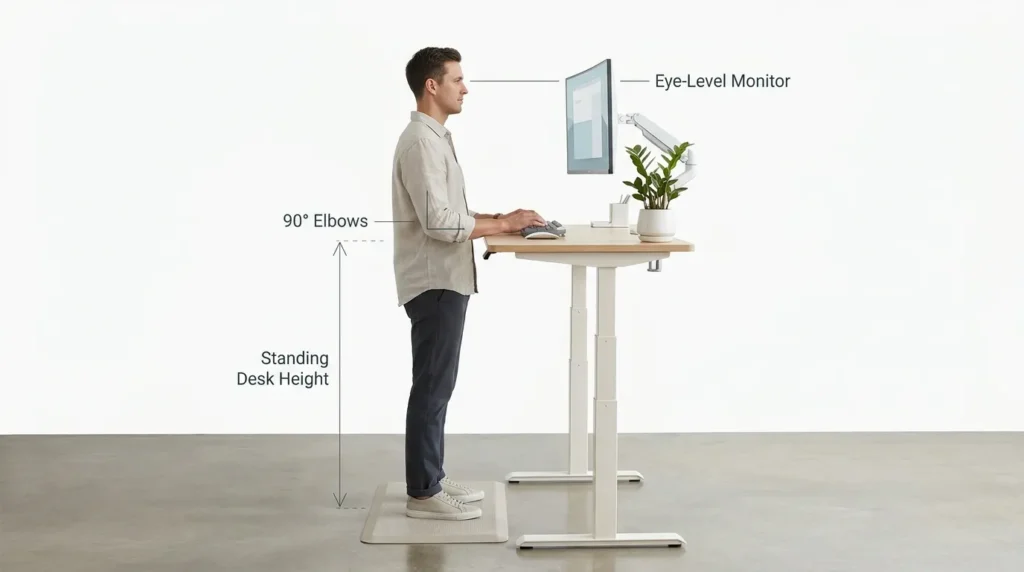
Standing Desk Height Formula
If you use a standing desk:
Standing Desk Height = Standing Elbow Height
- Stand upright
- Bend elbows at 90°
- Measure floor to elbow
Desk surface should match that height.
Keep wrists neutral, not bent upward.
Signs Your Setup Is Correct
✔ Shoulders relaxed
✔ Wrists straight
✔ Feet flat
✔ Knees at 90°
✔ No reaching forward
✔ Lower back supported
If discomfort decreases after adjustment, you’re likely closer to ideal positioning. Neutral posture is a key for minimizing stress in muscles, tendons, nerves and bones.
Common Mistakes
❌ Matching desk height to chair instead of body
❌ Ignoring foot support
❌ Prioritizing monitor over elbow alignment
❌ Sitting too low because it “feels relaxed”
❌ Raising chair but forgetting lumbar support
Ergonomics is about alignment,not comfort alone.
When a Height Adjustment Makes Immediate Difference
If you feel:
- Upper trapezius tightness
- Wrist soreness
- Lower back compression
- Tingling in hands
Adjust desk or chair height before buying new equipment.
Often, a 1–2 inch change makes a major impact.
Quick Setup Checklist
✔ Measure seated elbow height
✔ Adjust desk to match
✔ Adjust chair to support 90° knees
✔ Confirm feet flat
✔ Position monitor correctly
✔ Add lumbar support if needed
Small adjustments prevent long-term discomfort.
FAQ
What is the ideal desk height?
Desk height should align with your seated elbow height at 90°.
What is the correct chair height?
Chair height should allow feet flat on floor and knees at 90–100°.
Are standing desks better for height customization?
Yes. Adjustable desks allow precise matching to your elbow height.
Can wrong desk height cause back pain?
Yes. Poor height alignment increases strain on shoulders and lower back.